
Office Phone Number: (832) 644-8930
New Patient Appointments: (346) 662-1220
Your heart is a natural wonder. It’s tied to your feelings of joy, excitement, fear, peace and countless other emotions that define our lives. Our hearts speed up and slow down in sync with our emotions like an orchestra behind an opera.
The heart is also essential for the proper functioning of every other organ. It pumps oxygen-rich blood throughout every inch of our bodies. At times, some hearts may need extra help doing that. A pacemaker helps the heart when it suffers from irregular or slow rhythms, which can have a harmful effect on the rest of your body.
Pacemakers for the heart are small electric devices that ensure your heart beats properly. Surgeons implant pacemakers in the chest or abdomen to treat heart rhythm problems. These problems include arrhythmias, bradycardia and tachycardia. Arrhythmias are abnormal heart rhythms that cause your heart to miss beats, while bradycardia is when the heart beats too slowly. In contrast, tachycardia is when your heart beats too fast. The most common conditions pacemakers treat are arrhythmias and bradycardia.
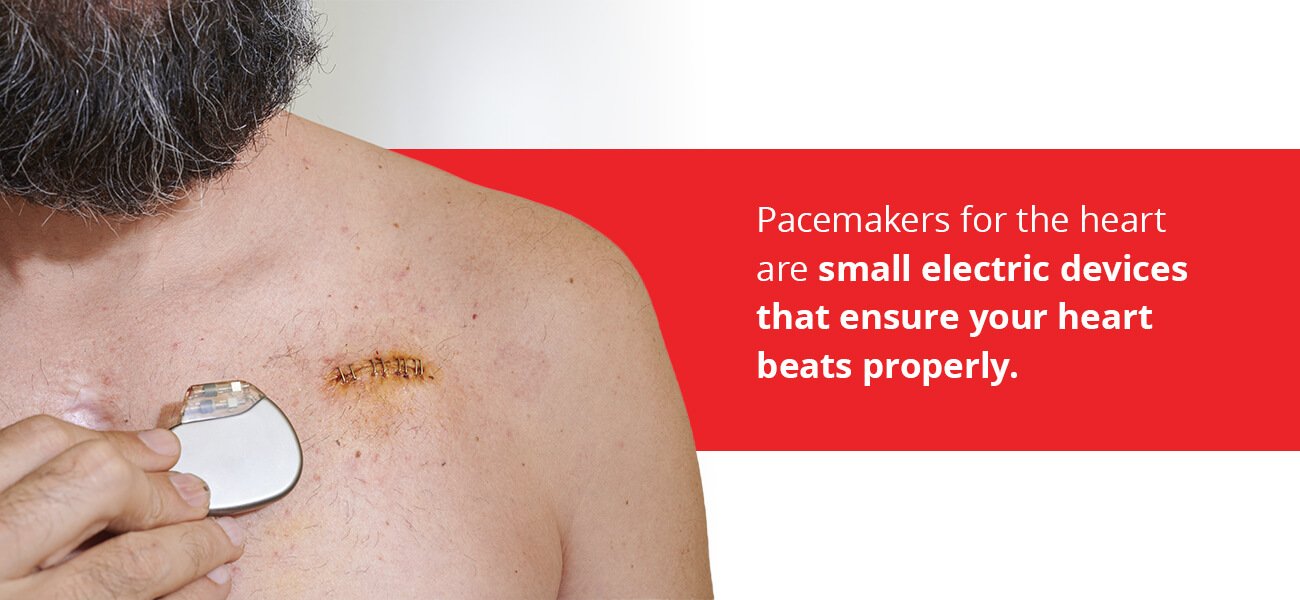
Most pacemakers are smaller than a matchbox, and newer ones weigh around 28 grams. Pacemakers have three main parts — wires, also called leads, electrodes and a pulse generator:
Here are some different types of pacemakers:

Your heart has an electrical system known as the sinoatrial node, also called the SA node or sinus node. The sinus node cells are the natural pacemakers for the heart, as they regulate your heart’s rhythm. Pacemakers mimic the action of these cells. Sinus node cells produce electrical impulses throughout the heart that make it contract and pump out blood. These cells may need extra help regulating your heart’s rhythm for various reasons, such as heart damage or sinus node dysfunction.
Pacemakers provide this help by sending electrical impulses to the heart when it is beating too slowly or at an irregular rate. The electrical signals stimulate the heart to help it beat at an ideal rate. A physician programs the pacemaker to send controlled electrical energy to the heart whenever it beats too slowly or fast. They program the pacemaker before implanting it into the chest and heart.
The battery-operated computer monitors your heartbeat. By monitoring the heartbeat, the pulse generator can deliver the energy at appropriate times. The computer stores the information about your heart rhythm and sends it to a doctor for review. Your doctor reviews this information at each follow-up appointment through a special tool placed over your chest while the pacemaker sends the information remotely. Your doctor can give you a device and helpful instructions to use at home for telehealth appointments.
Like any battery-powered device, pacemaker batteries eventually run out of juice. Most pacemaker batteries last around 6-15 years. That said, the battery life span depends on the settings your doctor programs and how much therapy you need. In general, the more impulses the pulse generator sends, the quicker the batteries will run out.
The batteries are permanently sealed inside the pacemaker. Thus, replacing the batteries requires the replacement of the pacemaker. Your doctor will check your battery status at each follow-up appointment.


A pacemaker implantation procedure involves the use of a local anesthetic and sedative. You will be awake but sleepy, relaxed and numb to any pain caused by the procedure. The local anesthetic numbs the area so you feel no pain, while the sedative keeps you relaxed during the procedure. Overall, the procedure takes 1-2 hours to complete.
The general process for a pacemaker implantation procedure is as follows:
There are also various approaches to how pacemakers are fitted. The approach your doctor uses depends on the type of pacemaker they’re providing you with. The three main approaches are the catheter-based, transvenous and epicardial approaches.
The catheter-based approach only works for leadless pacemakers when only one heart chamber needs a pacemaker. With this approach, the surgeon inserts a catheter into an artery — usually near your groin — and threads it toward your heart. Once there, the leadless pacemaker attaches to the heart wall.
The most common pacemaker implantation approach is the transvenous approach. Venous means “of the veins,” so transvenous pacemaker implantation means the pacemaker is implanted through your veins.
With the transvenous approach, the surgeon makes a small incision to access a large vein. This vein runs underneath your collarbone from your heart to your arm or neck. The incision is approximately two inches long on the left side of your chest. Using fluoroscopy, or X-ray-guided imaging, the specialist guides the leads through the vein and attaches them to the heart wall. Once the leads and electrodes are positioned correctly, they’re connected to the pacemaker. The surgeon then inserts the pacemaker into a small pocket underneath the skin of your upper chest.
With the epicardial approach, the surgeon attaches the leads to the heart’s outer surface rather than the inner chamber walls. This method is most often used for children or individuals undergoing heart surgery during the procedure.
Unlike the transvenous and catheter-based approaches, the epicardial approach uses a general anesthetic, meaning you’ll be asleep during the procedure. During this time, the surgeon creates a small incision in the lower chest and attaches the electrode to the outer surface of your heart, known as the epicardium. They then connect the other end of the lead to the pulse generator and place the pulse generator in a pocket created under the skin of your abdomen.
The greatest benefit of pacemakers is that they can prevent your heart from stopping prematurely — effectively saving your life. They can also alleviate or prevent many symptoms of heart rhythm problems. Some of these symptoms include:
By alleviating or preventing these symptoms, pacemakers can measurably improve your life. With a pacemaker, you may experience:
Severe complications from pacemakers are unusual. Still, every surgical procedure has risks. Some of those risks exist with any surgery. These include infection, allergic reactions, blood clots and bleeding. Others apply more to the pacemaker implantation procedure.
Some uncommon risks unique to the pacemaker implantation procedure include:

While there are some things you can’t do with a pacemaker, your doctor can help recommend lifestyle adjustments as needed.
Some things you’ll need to avoid with a pacemaker include:
To avoid post-procedural complications with your pacemaker, follow these pacemaker precautions:
Doctors may recommend a pacemaker to anyone with a condition that causes an irregular, slow or fast heartbeat. Some of these conditions include:
You can get a pacemaker implanted in either an outpatient setting, like here at Modern Heart and Vascular, or as part of your stay in the hospital. Most routine pacemaker implantation procedures can be performed in an outpatient setting. If increased complication risks exist, your doctor may recommend having the procedure in the hospital so the surgeon and nurses can continue monitoring you after the procedure.
Modern Heart and Vascular is an excellent option for outpatient pacemaker care around Houston, Texas. We have cutting-edge equipment and highly skilled cardiologists at each of our clinics. All our cardiologists are board-certified and trained in surgery. We also have many excellent nurse practitioners who can provide high-quality heart health care. Besides pacemaker services, we provide care for any heart-related issue. Our focus is prevention, helping you live well with a healthy heart.

CARDIOVASCULAR CENTERS IN HOUSTON, TEXAS
Modern Heart and Vascular, a preventive cardiology medical practice, has several offices around Houston. We have locations in Humble, Cleveland, The Woodlands, Katy, and Livingston.
We are Modern Heart and Vascular Institute, a diagnostic and preventative medicine cardiology practice.
Every heart has a story… What’s yours?
Book an Appointment Today
At the Modern Heart and Vascular Institute, we offer state-of-the-art cardiovascular care with innovative diagnostic tools and compassionate patient care. Our priority at Modern Heart and Vascular Institute is prevention. We help patients lead healthier lives by avoiding unnecessary procedures and surgeries.
Contact us online to learn more and book an appointment. If you’d like to learn more about our practice, read our providers’ bios.
This article does not provide medical advice. It is intended for informational purposes only. It is not a substitute for professional medical advice, diagnosis, or treatment. If you need cardiovascular care, please call us at 832-644-8930.
Every heart has a story…What’s yours?
Choose your appointment at one of our 7 locations